The Clinical Case for Omelo: Five Things No Other Pet Health Product Does
Quick Answer
Pets hide their pain. It is an evolutionary survival instinct. By the time you notice something is wrong, disease is often advanced. Omelo is the first consumer product that detects the mathematical deviation from your pet's normal before the concealment becomes complete. Here is the clinical science behind how it works.
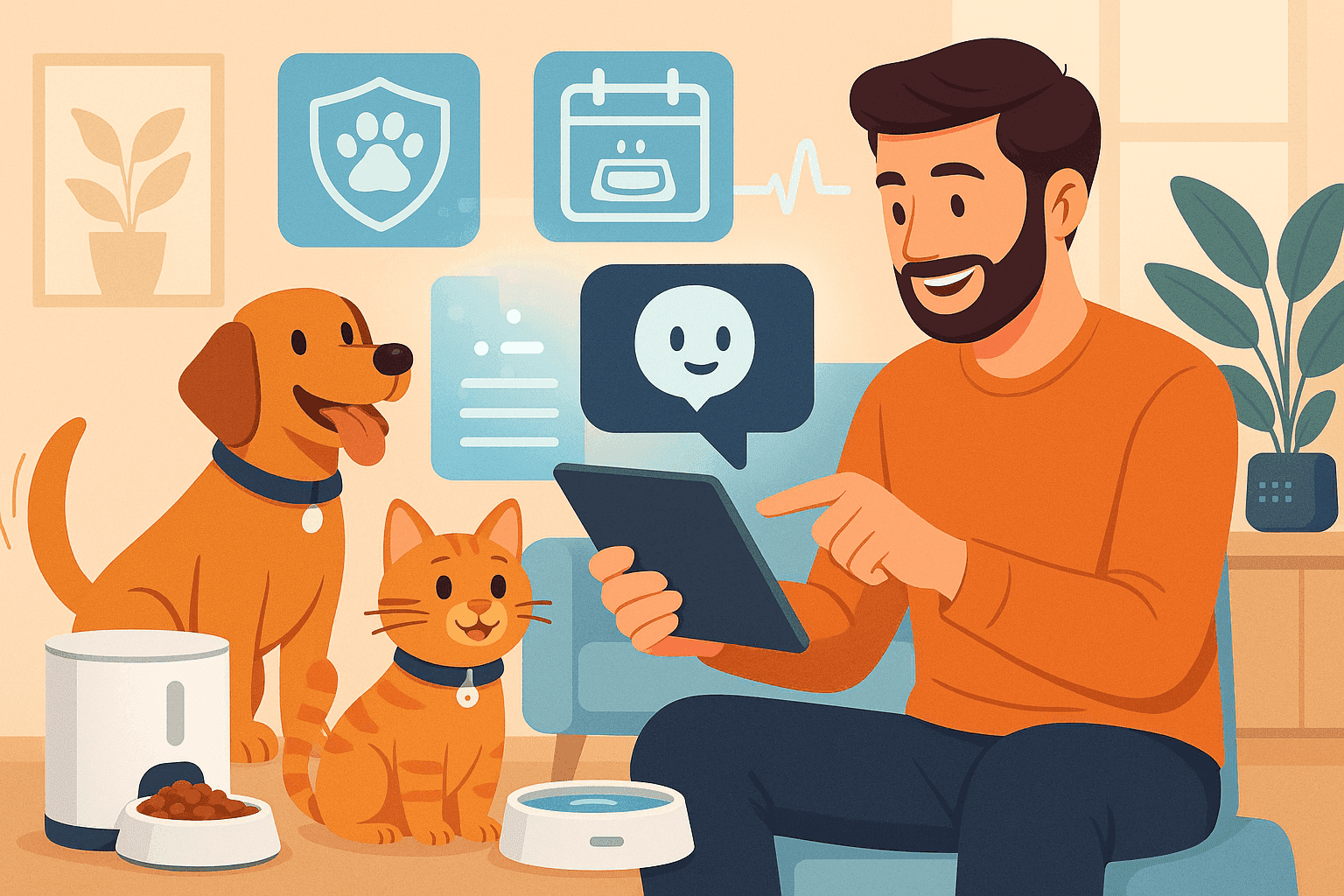
The problem every pet parent faces and nobody names
A dog with early kidney disease does not limp. A cat with early hyperthyroidism does not cry out. They adjust. They compensate. They hide. Some diseases progress slowly enough that the pet accommodates the change, adjusting to dull aches and continuing their activities as if nothing is wrong.
The clinical consequence is devastating. In most dogs, cancer is detected after the development of clinical signs, often when the disease is advanced. This is not a failure of veterinary medicine. It is a failure of observation infrastructure. Vets are brilliant. They simply do not have data from the 363 days they do not see your pet.
What Omelo does differently: measuring around the concealment
A pet that is hiding illness still eats slightly less. Still moves slightly differently. Still sleeps in slightly altered patterns. Those deviations, invisible to a single vet visit, are visible to a system watching daily across months. Omelo is not trying to see through the concealment. It is measuring around it.
Behavioural signals come before blood test results
The most common early signs include decreased activity, decreased interaction with family members, lethargy, decreased appetite, and changes in resting behaviour. These are not secondary indicators. These are the signals that appear before blood panels show abnormalities.
An appetite change precedes an abnormal blood panel. Lethargy precedes inflammatory markers. Behavioural patterns are the early warning system that biology has not yet caught up to. A blood test catches what has already become measurable. A behavioural baseline catches what is becoming.
Products like Omi Health capture biochemical data twice per year. Omelo captures behavioural data every single day. These are not competing approaches. Behavioural data is earlier in the disease timeline. By the time a blood panel shows abnormal kidney markers, Omelo has already detected weeks of appetite and hydration changes that preceded them.
The individual baseline: why population averages fail your pet
A Labrador that normally eats 400g per day and drops to 280g has shown a 30% appetite decline. That same 280g intake in another Labrador might be perfectly normal. The number is not the signal. The deviation from individual normal is the signal.
Precision medicine in human healthcare is built on individual baselines: your specific biomarkers, your specific genetic profile, your specific normal. Omelo applies the same principle to veterinary behavioural monitoring.
After 30 days of daily logs, Omelo has established your pet's baseline. Not the breed's baseline. Your specific pet's normal appetite range, normal activity level, normal sleep duration. Every subsequent deviation is compared to your pet's own prior self, not to a population average or a clinical threshold.
Get a 3-question triage and a vet-reviewed action plan.
Free to try. 30 seconds. No card to start. Rated 4.8 on Google Play.
This is the only clinically valid comparison for individual health assessment. And it is only possible through continuous longitudinal observation. No blood test company can build a per-individual baseline from two annual samples. The mathematical signal-to-noise ratio requires continuous data. Omelo has continuous data. Nobody else does.
Convergence detection: when two small things become one big thing
In human emergency medicine, clinical scoring systems like the qSOFA score for sepsis are built on the mathematical principle that the co-occurrence of multiple indicators has exponentially greater diagnostic weight than any individual indicator. The convergence of signals is the signal.
No consumer pet health product has ever operationalised this. There has been no tool that watches multiple health systems simultaneously, detects their simultaneous decline, and surfaces the combined pattern to a pet parent before they noticed anything unusual.
Omelo's convergence detection system monitors appetite, activity, sleep, hydration, elimination, and symptom frequency in parallel. When two or more systems show simultaneous decline, the system generates a convergence confidence score estimating the probability that the declining metrics are clinically related rather than coincidentally co-occurring.
Your pet's appetite score declining while vomit episode frequency increases is not two problems. It is one problem getting worse. Omelo sees the crossing before you see the crisis.
Why ChatGPT gets pet health wrong 50% of the time
In a blind comparison conducted in April 2025, veterinarians reviewed simulated pet-owner conversations. ChatGPT achieved an accuracy score of 50%, while a purpose-built veterinary AI achieved 81%. ChatGPT, arguably the most capable general-purpose AI available, performed at coin-flip accuracy on pet health triage.
The reason is not that ChatGPT is unintelligent. It is that clinical reasoning requires structured sequential questioning, not open-ended conversation. Omelo's two-call clinical pipeline implements exactly this. The first call builds structured clinical context from the pet's longitudinal record and the current query. The second call runs the enriched prompt through a reasoning model trained on over 100 veterinary decision trees.
Omelo also maintains per-pet pharmacological memory. Every medication administered to a specific animal and its observed outcome is recorded. A medication that produced adverse outcomes for your pet will never be recommended again, regardless of how clinically indicated it appears based on symptoms alone. This is personalised medicine at the individual animal level.
The sum of the five parts
Blood test companies provide snapshots without behavioural context. Generic AI provides responses without clinical structure or individual memory. Wearables provide activity data without clinical interpretation. Symptom checkers provide population guidance without individual baselines.
Omelo is the only system that combines all five into a single persistent knowledge record specific to one animal. Without hardware. Without lab costs. Without the episodic model that leaves 363 days of your pet's health unobserved.
Daily observation is ideal, even for healthy pets. Noticing subtle changes early can prevent serious illness. Omelo makes daily observation automatic, continuous, and clinically intelligent. No other product in the world does all three simultaneously.
Get a 3-question triage and a vet-reviewed action plan.
Free to try. 30 seconds. No card to start. Rated 4.8 on Google Play.
More in Inside Omelo

Breed-Specific Health Guides
View all breed health guidesWas this article helpful?
Dr. Anubha
Veterinarian · Medical Reviewer
Reviews all clinical and triage content on Omelo. Hands-on small-animal practice experience across vomiting, dermatology, vaccinations, and emergency triage. All Omelo recommendations pass through Dr. Anubha before publication.
Read Dr. Anubha's full bio →